The Central Archives for the History of the Jewish People
The Central Archives for the History of the Jewish People (CAHJP, in future: Archives of the Jewish People, AJP) were founded in Jerusalem in 1939 and hold collections from thousands of Jewish communities and international Jewish organizations worldwide. The original material is divided into three primary collection categories: Jewish communities, international Jewish organizations, and private collections.
Collection
The CAHJP include the archives of several major international Jewish organizations, including JCA, ORT, OSE, and some branches of the Alliance. Likewise, the archives of most successor organizations that were active after the Shoah, such as JRSO, URO, JTC, and the Claims Conference, are held in the AJP’s collection.
Jews did not live in isolation from the surrounding society, and many state, district, municipal, and church archives preserved extensive documents about Jews. Since its founding, the CAHJP has initiated surveys and reproduction projects in hundreds of archives worldwide, where numerous documents on Jewish life have been found and extensively copied and microfilmed. In addition, the CAHJP provides inventories and finding aids for archival material from other archives, also worldwide.

The building of the National Library of Israel, which houses the CAHJP, 2026.
Background and Prehistory
The history of Jewish archival work began with an article published by Simon Dubnow in 1891 in the Russian newspaper “Voskhod,” in which he presented a plan for the collection and cataloging of documentary material relating to Russian Jewry. The article garnered enthusiastic responses from the Russian-Jewish intelligentsia and led, a year later, to the founding of “Jewish Historical-Ethnographic Commissions” in St. Petersburg, and later also in Kiev.
A second important step was the establishment of the “Gesamtarchiv der deutschen Juden" (General Archive of German Jews) in Berlin in 1905, an initiative attributed to Eugen Täubler, whose collections are now located in Jerusalem and Berlin. Today’s CAHJP—then known as the JGHA—saw itself as the successor to the “Gesamtarchiv der deutschen Juden” and also as the heir to the destroyed communities, aiming to create a fitting memorial to German Jewry through the “Ingathering of the Exiles,” the gathering or repatriation of the scattered records of the dispersed people.
As early as its founding in 1924, the Jewish Historical Society of Israel [then known as The Palestine Historical and Ethnographical Society] identified the establishment of a national and central archive as one of its most important tasks. At that time, the aim was to establish an archive that would collect materials and documents on the history of the Zionist national movement and the history of the new Yishuv in Palestine. This plan was finally realized in 1935, after the General Zionist Archives had been transferred from Berlin to Jerusalem, leading to the establishment of the Central Zionist Archives . With the founding of the Department of History at the Hebrew University in 1936, the need arose to provide the equipment and tools for historical research—namely, to establish an archive.
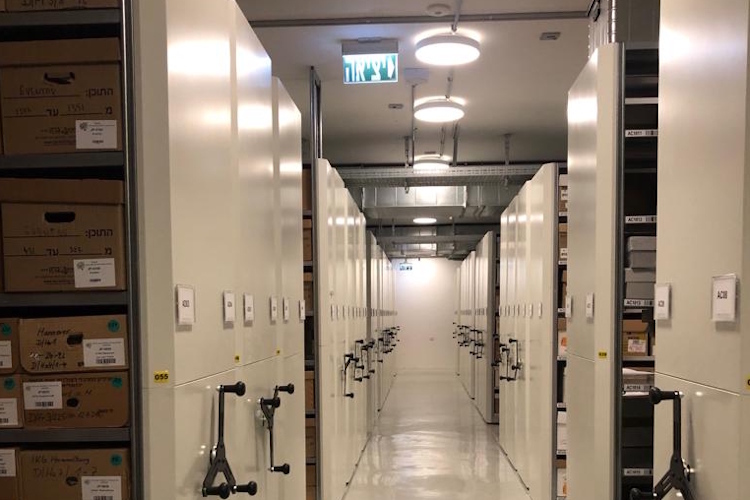
Storage room at the Central Archives for the History of the Jewish People in Jerusalem.
The Founding of the Jewish Historical General Archives
Plans to secure the Hebrew University as the patron and financier of this project failed, leading in 1939 to the founding of the Jewish Historical General Archives (JHGA)—now known as the CHAJP—initially outside and independent of the Hebrew University. It would take until 1944 for Dinur to mediate between the Jewish Historical General Archives and the Hebrew University and reach an agreement, as a result of which the Jewish Historical General Archives became affiliated with the Palestine Historical and Ethnographical Society and thus with the Hebrew University.
As early as April 1944, the administration of the then-JHGA was called upon to collect material on the persecution in Germany and in the countries occupied by the Nazis. Around the world, organizations and institutions such as the Wiener Library in London, the Jewish World Congress and the YIVO Institute in New York, the Centre de Documentation Juive Contemporaine in Paris, as well as the Jewish Agency’s Relief Committee, the Zionist Federation of Labor Unions, and the Central Zionist Archives in Israel, began joint efforts to locate the material and explore ways and means of transferring the files to Jerusalem. The goal of these efforts was twofold: both for legal reasons related to the subsequent war crimes trials and for scholarly and historical purposes. After the war, it was discovered that significant quantities of the Jewish archival material confiscated by the Gestapo in 1938 had been stored in the respective German state archives, and in the early 1950s, the initially small archive underwent a significant expansion, when, following protracted negotiations between the State of Israel and German government agencies as well as local Jewish organizations, the remaining Jewish archival materials were transferred to the Jerusalem archive for safekeeping by official order. A special case is the archive of the Hamburg community, whose holdings were divided between the Hamburg State Archive and the Archives of the Jewish People in Jerusalem.
The CAHJP Today
The current Central Archives for the History of the Jewish People (in future: Archives of the Jewish People) were formally established in 1969 by seven public and academic institutions as an independent public institution and public limited company. Until 2015, these institutions comprised the members of the CAHJP’s board: the Israeli government, the Jewish Agency, the Historical Society of Israel, the Israel Academy of Sciences and Humanities, the Hebrew University of Jerusalem, Tel Aviv University, and Bar-Ilan University.
Today, the main shareholder of the CAHJP is the National Library of Israel (NLI), with both institutions collaborating closely in the areas of digitization and accessibility, outreach, and conservation.

An example from the collection Altona Hamburg Wandsbek, CAHJP.