Hamburg State Archives
The Hamburg State Archives looks back on over 300 years of history as an independent administrative unit. Its origins date back as far as the Middle Ages. A municipal archive is first mentioned in a document from 1293. This served as a repository for legally significant documents and was directly supervised by the City Council. Nothing changed in this respect, even when a dedicated archivist was appointed in 1648.
In 1710, management of the archive was entrusted on a full-time basis to a member of the Senate, then known as the Secretarius. This marked the beginning of the State Archives’ era as an independent administrative institution. For a long time, it reported directly to the Senate. Since 2006, it has been an office of the Authority for Culture and Media.
Areas of responsibility
The work of the State Archives today is characterized by three equally important areas of responsibility that have developed over time. Until the nineteenth century, the archive’s role in preserving legal records was at the forefront of its activities. In accordance with the centuries-old principle of ius archivi – that is, the preservation of evidence through uninterrupted official custody – it has contributed to ensuring that the city and its citizens can permanently document their rights.
Since the nineteenth century, the archive has become increasingly important for historiography. The wealth of historically significant documents preserved by the archive continues to serve as an inexhaustible source of unique information for research, scholarship, and private individuals in their work. The archivists themselves also contributed to the archive’s reputation by publishing their own historical works. Johann Martin Lappenberg (1794–1865), one of the most esteemed Hamburg scholars of the nineteenth century, deserves special mention here.

Hamburg State Archives, photo: Nina Schwenke.
With the advent of IT in public administration, the State Archives has intensified its activities in a third area of responsibility: advising government agencies. Due to its longstanding expertise in the organization of administrative records, the State Archives brings its expertise to bear on issues of records management. This expertise is indispensable for the handling and long-term preservation of electronic records.
The Archive Building
In spatial terms, the journey from the medieval ark to today’s functional archive building involved many temporary solutions. For instance, the archive was housed in the old town hall on Neß as well as in the building of the former Courantbank. There, a large portion of the archival materials was destroyed in the Great Fire of 1842, which devastated a quarter of the city. Afterward, the archive moved into rooms in the today’s city hall, which soon became too small for the growing volume of archival materials. However, it was not until 1972 that a new building was inaugurated on ABC-Strasse.
Since 1997, the State Archives has been located at their current site on Kattunbleiche in Hamburg-Wandsbek. The building, designed by architect Jan Störmer, is divided into two building complexes. Next to a modern, administrative building with a reading room and public area stands a blue, windowless stacks block. A clever passive climate control system, which dispenses with costly and environmentally harmful technical aids, ensures that the archival materials are stored there under optimal conditions for their long-term preservation. From the outside, enlarged replicas of important archival documents hint at the valuable contents of the blue cube. Standing in front of it is the sculpture “Die Lauschende” (“Woman listening”) by the sculptor Gustav Seitz.
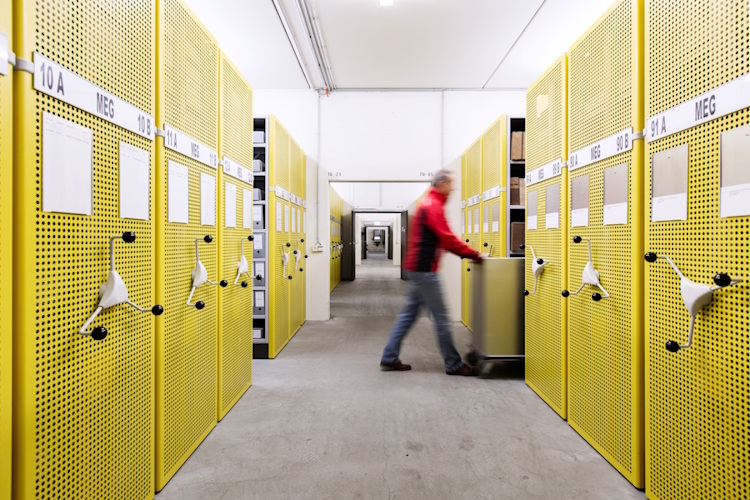
Storage room with filing cabinets, ©Roeler.
Archival Records and Access
As a state and municipal archive, the State Archives selects records from the public bodies of the Free and Hanseatic City of Hamburg, as well as from private entities, that possess lasting value in order to preserve them as archival materials for the long term. A notable example of records from private entities are the documents of the former Jewish congregations (Bestand 522-1 Jüdische Gemeinden – “Collection 522-1 Jewish Congregations”).
The archival records are cataloged so that they can be made available to citizens, academic researchers, educational institutions, and businesses, as well as to the City Council and Senate, the administration, and the judiciary. Access is provided primarily through consultation in the reading room. In addition, the State Archives offers not only cataloging information for research via its Archival Information System and portals such as the German Digital Library or the Archive Portal-D, but also digital representations of archival materials available for retrieval.
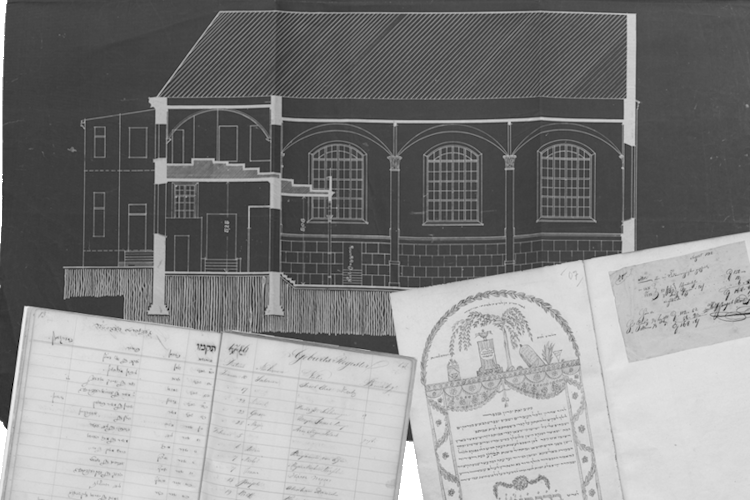
Images of sources from the collection Jüdische Gemeinden, Hamburg State Archives, 522-1 Jüdische Gemeinden, Nr. 64, Nr. 74, Nr. 189.