Institute for the History of the German Jews
The Institute for the History of the German Jews (Institut für die Geschichte der deutschen Juden – IGdJ) was founded in 1966, the first institution in the Federal Republic of Germany dedicated exclusively to the study of German-Jewish history. As a non-university research institute, it carries out research and outreach projects, such as those on migration, legal, and architectural history; the Shoah and its aftermath; Jewish life in the present; current issues of remembrance and commemoration; and Digital Jewish History.
Vorgeschichte
The history of the IGdJ’s founding is closely linked to the discussions regarding the handling of the archives of the Jewish congregations in the Hamburg area (Altona, Hamburg, Wandsbek) after 1945. To be sure, the congregation archives had largely survived National Socialism and the Second World War unscathed due to their transfer to the State Archives between 1938 and 1944 in the context of the impending confiscation by the Gestapo. However, a conflict arose in the postwar period regarding the future storage location as well as the authority to interpret this extensive source material documenting over 400 years of Jewish history. The Jewish Trust Corporation, acting as a trustee for Jewish assets and cultural property in the British occupation zone, filed a lawsuit in the Hamburg Regional Court seeking the return of the files in order to transfer them to Israel, while the Free and Hanseatic City of Hamburg wanted the source materials to remain on site. The legal dispute was finally resolved in 1959 through a settlement that also laid the foundation for the IGdJ. This settlement not only provided for the division of the sources between the Hamburg State Archives and the Jewish Historical General Archives (later the Central Archives for the History of the Jewish People), but also prompted the establishment of a research institute to scientifically catalog the source collection in Hamburg.

Exterior view of the IGdJ.
The Founding
Much like the conflict over the archive’s fate, the institute’s founding and the appointment of its leadership were also accompanied by discussions. The issues to be negotiated in this context were the same: Who should and could research and represent German-Jewish history, and where? Could historical research on Jewish history be conducted in the land of the perpetrators?
The establishment of the institute was driven by individuals such as Dietrich Gerhardt, a professor of Slavic studies at the University of Hamburg; Eric M. Warburg, a banker originally from Hamburg; and Hans W. Hertz, a Hamburg notary. Warburg and Hertz had already been involved in the founding of the Working Group for Research on the History of the Jews in Hamburg in 1953, led by Fritz Fischer, professor of medieval and modern history at the University of Hamburg, and they were also actively involved in the conflict over the preservation of the congregation archives. Ultimately, the initiative for a research institute found support not only at the University of Hamburg but also from the Hamburg Scientific Foundation and the Hamburg City Parliament.
Abroad, however, particularly among former Hamburg residents of Jewish descent in Israel, an adverse attitude prevailed. In addition to the location, personnel issues also played a central role from the outset. Criticism grew both at home and abroad when the plan became known to appoint Karl Heinrich Rengstorf, director of the Institutum Judaicum Delitzschianum in Münster and professor of Protestant theology, as director. His role as chairman of the Evangelical-Lutheran Central Association for Mission among the Jews seemed to critics to be incompatible with unbiased research into German-Jewish history; his appointment was therefore considered unacceptable by many, resulting in his withdrawal.
With the election of the German-Israeli historian and philosopher of religion Heinz Moshe Graupe – who was born in Hamburg and fled to Palestine in 1933 – as the first director of the IGdJ, the conflict was resolved for the time being.
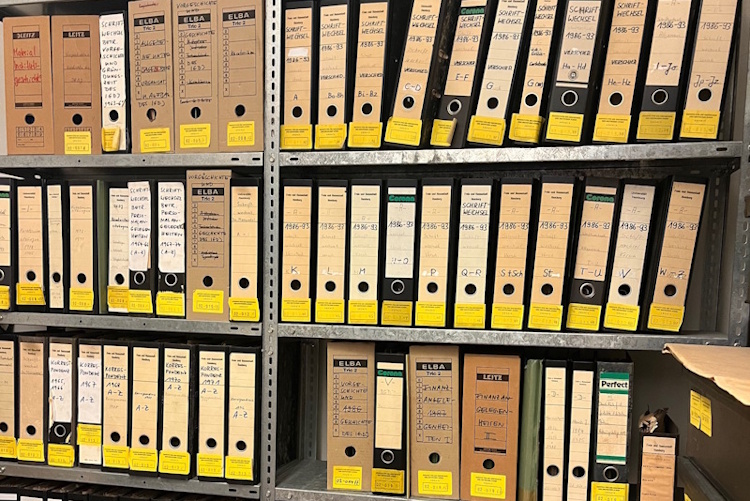
Photograph of the IGdJ Archive.
Forschungsprofil und Aufgaben
In the decades that followed, under various directors and within the context of the dynamically evolving field of Jewish Studies, both the research profile and the mission of the IGdJ underwent changes. Work with and on the sources of Hamburg’s Jewish history, however, remains a constant: While in the early decades the focus was primarily on extensive source collections pertaining to the city’s more than 400-year Jewish history – edited by figures such as Heinz Moshe Graupe, Gunter Marwedel, or Ina Lorenz –, today work with and on the sources of Hamburg’s Jewish history stands at the center of the institute’s digital offerings. To mark its 50th anniversary, the IGdJ launched the online source edition entitled “Key Documents on German-Jewish History,” which provides sources on the Hamburg’s Jewish history as digitized materials and scientifically edited transcripts, and contextualizes them through accompanying interpretive and background texts. A large portion of the sources processed in the project originate from the State Archives of the Free and Hanseatic City of Hamburg and the Central Archives for the History of the Jewish People in Jerusalem. Thus, the Key Documents Edition represents a first step toward a virtual consolidation and processing of the two collections in the spirit of the digital turn in the humanities. At the same time, the Institute itself makes its visual archival materials available in the picture database “Jewish past and present” (Bildarchiv “jüdische geschichte&gegenwart”) and is increasingly perceived and sought after as a preservation facility with respect to the acquisition of family collections, so that, in addition to research, the preservation of archival materials is once again gaining importance.
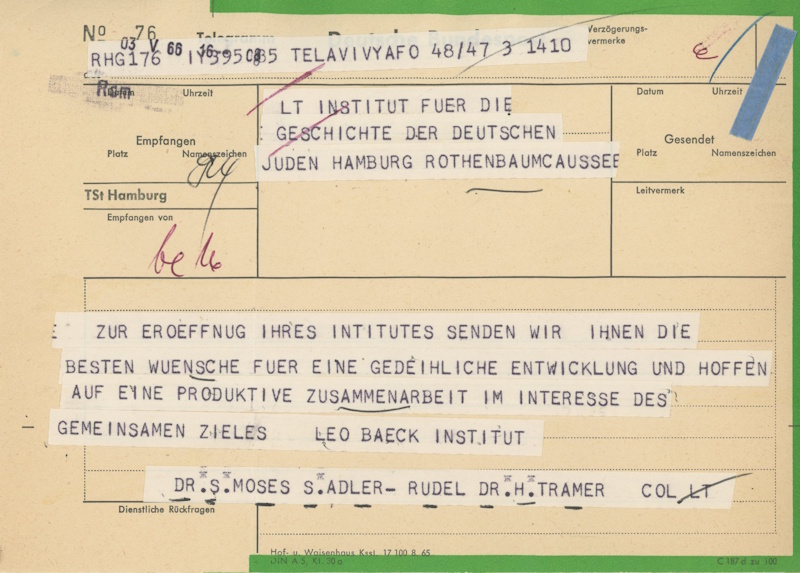
Telegramm from S. Adler-Rudel and H. Tramer to the Institute for the History of the German Jews, Mai 3, 1966, IGdJ-Archive, 02-006.
For a detailed account of the history of the founding of the Institute for the History of the German Jews: Björn Siegel, “Verworrene Wege. Die Gründungsphase des IGdJ,” in: 50 Jahre – 50 Quellen. Festschrift zum Jubiläum des Instituts für die Geschichte der deutschen Juden, ed. by IGdJ, Hamburg 2026, pp. 26–53, available online at: https://igdj-hh.de/fileadmin/user_upload/igdj_50jahre-50quellen-festschrift.pdf
For more information on the Für weitere Informationen zu den Archivbeständen, schauen Sie gerne im Bildarchiv vorbei oder kontaktieren Sie uns unter kontakt@igdj-hh.de.
Key Documents on German-Jewish History: https://keydocuments.net/
Picture database “Jewish past & present”: https://bildarchiv-juedische-geschichte.de/