Contents
Archival division and founding history
The digitization projects at the archives in Hamburg (State Archives) and Jerusalem (Central Archives for the History of the Jewish People) will in the future enable a virtual consolidation of the divided archival collection, which reflects the over four-hundred-year history of Hamburg’s Jewish congregations, and offer new impetus for DH-supported analyses of this historically rich collection of sources. This virtual merger of digitized materials and research data, jointly pursued by the Hamburg State Archives, the Central Archives for the History of the Jewish People, and the Institute for the History of the German Jews, is the result of many years of collaborative efforts and the commitment of individuals at the IGdJ, in the archives, and within the Jewish community. The project is based on the long (divided) history of the collection:
The basis for today’s collaboration is the agreement dated December 18, 1959. Before this agreement was reached, various protagonists and positions had been at odds with one another for years, disputing the future of the archives of Hamburg’s Jewish congregations. The struggle involved various individual actors and organizations, as well as ultimately the State of Israel and the Free and Hanseatic City of Hamburg, over the question of the (im)possibility of preserving and researching Jewish heritage in Germany, the country of perpetrators.
The question of how to deal with Jewish cultural assets without heirs was urgent after the end of the war, given the thousands of archives, libraries, and objects confiscated by the Gestapo. Thus, in the various occupation zones during the postwar period, conflicts smoldered over the handling of Jewish assets and cultural property that had survived the war.1 In Hamburg, the situation differed from that in most other major German cities, as the archives of the Hamburg Jewish congregations (Altona, Hamburg, Wandsbek, Harburg) – documenting over 400 years of Jewish history – had largely been preserved. The Jewish Congregation had transferred the records to the Hamburg State Archives in several stages from late 1938 through to 1944 – “anticipating confiscation by the Gestapo,” as Miriam Rürup writes.2


Pressure of persecution and transfer to the Hamburg State Archives
The transfer took place after the Berlin Gestapo office, in the context of the November pogroms of 1938, had ordered the confiscation and handover of Jewish archival materials to Berlin, with the Hamburg Gestapo also having initiated confiscation of Jewish archival materials. The director of the State Archives, Heinrich Reincke, subsequently advocated for the archival materials to remain in Hamburg so that they could be used – as he argued – by the department of personal records in accordance with Nazi legislation. The Gestapo agreed to the transfer of the archival materials. Jürgen Sielemann attributes Reincke’s behavior to his “regime-compliant attitude.”3
Whether the transfer – in light of the increasing pressure of persecution and the Gestapo’s restriction of the congregation’s ability to act – had been simultaneously sought and prepared by the congregation itself in advance, as Max Plaut later recalled in an interview, as well as the exact motives of the individuals involved, are subject to controversy in research and are increasingly being discussed critically with regard to the thesis of a “rescue” by the State Archives.4

Hamburg State Archives, photo: Nina Schwenke.
The legal dispute over the future of the German-Jewish heritage
It is clear, however, that the very circumstance of the collection – spanning the period from the seventeenth century to 1942 and documenting both Sephardic and Ashkenazi organizational forms – led to a long-standing legal dispute in the postwar period, and particularly after the founding of the State of Israel. The controversy involved debate of the question as to where German-Jewish heritage ought to be preserved and researched after the Holocaust.5
The various positions
Following the Holocaust, international Jewish organizations and the newly founded State of Israel considered Jewish life in Germany impossible and therefore wanted all records of German-Jewish history to be preserved in Israel. The Jewish Trust Corporation, which saw itself as a trust organization in the British occupation zone and thus as the legal successor to the German-Israelite Congregation of Hamburg, filed a lawsuit against the City of Hamburg’s Judicial Department before the Restitution Office of the Hamburg Regional Court, seeking the transfer of the archival holdings to Israel. The Jewish Historical General Archives (later: Central Archives for the History of the Jewish People, in future: Archives of the Jewish People), founded in 1939, also pressed for a transfer to Israel, where, in their view, a central and national archive for Jewish history was to be established, aimed at documenting the past for the future in light of persecution and extermination.6 The archive saw itself as the successor to the General Archive of German Jews. It was represented in the discussions by its director, Daniel J. Cohen, and the Israeli State Archivist, Alex Bein.
The Hamburg side included the Hamburg State Archives, with Erich von Lehe as Senior Archivist and Kurt Detlef Möller as Director of the Archives, as well as the City of Hamburg. The Jewish Congregation of Hamburg, with Chairman Harry Goldstein and board member Ludwig Löffler – who was also head of the Hamburg Restitution Office – was not itself a party to the legal dispute but actively followed the discussions over several years. In particular, it had been intensively involved since 1953 in efforts to negotiate an agreement regarding the archive’s future location.
In addition, various individuals participated in the negotiations and discussions at different times, such as notary Hans W. Hertz; banker Eric M. Warburg, who was originally from Hamburg and was by then living in exile in New York; Max Plaut, a survivor and former member of the congregation board; Jacob Jacobson, the former director of the General Archive of German Jews; and the philosopher of religion Martin Buber in Israel.
Our timeline provides an insight into the history of the archives of the Hamburg Jewish congregations since 1936, the debates surrounding their preservation, and the various positions, meanings and interpretations.
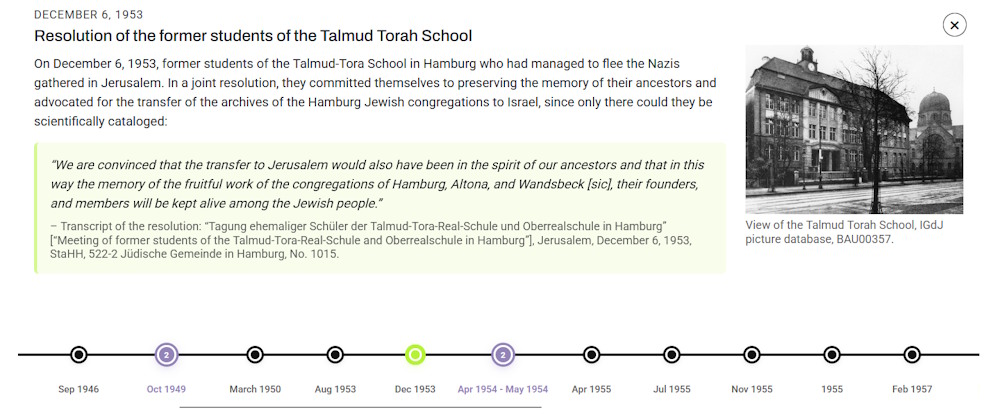
Short biographies of various individuals who participated in the negotiations and discussions can be found [here].
Continuities and disjunctures
Some of the same individuals who had already accompanied the transfer to the State Archives between 1938 and 1944 were also involved in the legal conflict. At the same time, the broader context had changed fundamentally, so that the negotiations were marked equally by continuities and disjunctures. Elisabeth Gallas also emphasizes this aspect in her study on the handling of Jewish cultural assets in the postwar period: “For the actors involved, this entailed, on the one hand, discussions concerning the shaping of [such] continued existence in the light of the Holocaust, thereby bringing into focus dimensions of disjuncture and continuity in Jewish life as a whole. [ … ] On the other hand, legal questions were at the center of the disputes over the restitution of cultural property.”7
At the same time, differing experiences and current situations played a role, such as those of the newly founded State of Israel, which also had to establish itself as a nation-state; the question of legal succession to the former congregation and the legitimacy of Jewish life in the land of the perpetrators; or the struggle of the newly founded Jewish Congregation for recognition as a public-law corporation by the City of Hamburg. The Hamburg Jewish Congregation’s search for a position in the conflict and the shifting priority, beginning in 1957, toward keeping the archival materials in Hamburg can likely also be explained in light of this complex (transnational) nexus as well as in light of a changing position towards a possible future for Jewish life in Germany.8
Settlement and division of the collection
When a settlement was reached between the parties involved in the late 1950s, it provided for the division of the archival holdings between the two archives in Hamburg and Jerusalem; any part of the holdings not present in the original form in either of the location was to be microfilmed. Since then, approximately 35% of the originals have been housed in Jerusalem, where a total of 50 linear meters are preserved, while Hamburg holds 70 linear meters. This means that researchers in both Hamburg and Jerusalem have access to an archival collection of extraordinary historical significance for German-Jewish history, spanning from the early seventeenth century well into the Second World War.
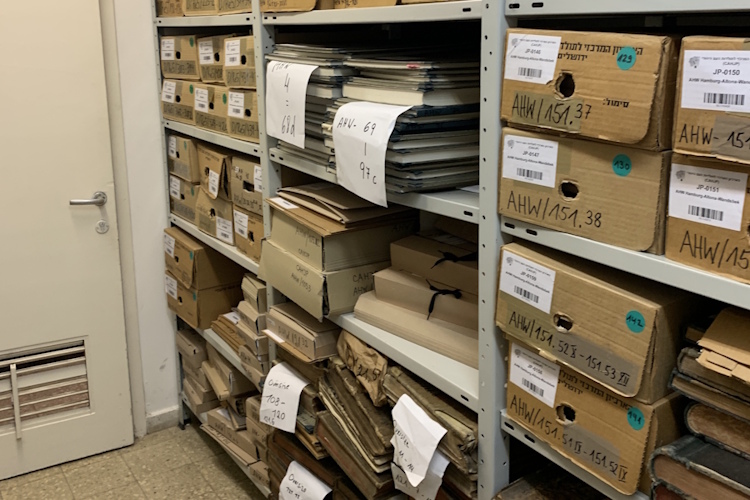
Archive boxes collection Altona Hamburg Wandsbek, CAHJP.
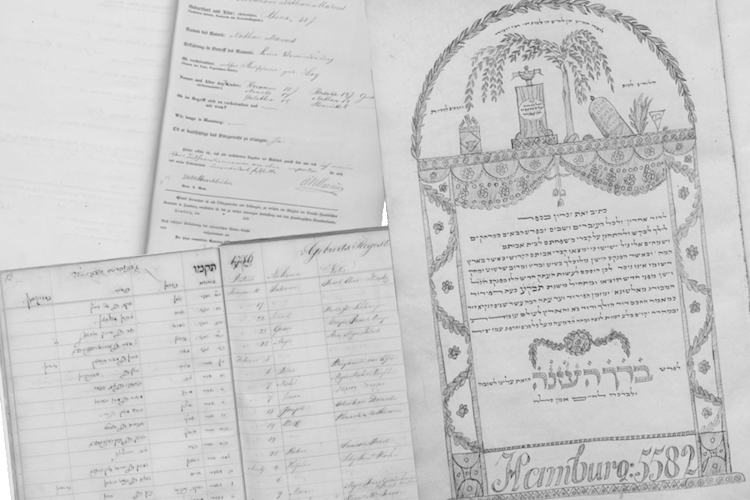
Images of sources from the collection Jüdische Gemeinden, Hamburg State Archives, 522-1 Jüdische Gemeinden, Nr. 64, Nr. 74, Nr. 372 Volume 1.
Digitization and virtual consolidation
The digitization of the collections, now carried out at both institutions, opens up further possibilities for the future. To explore these opportunities together, exchange digitized materials, and harmonize cataloging and metadata, all three institutions are engaged in an ongoing process of collaboration. This website offers an initial introduction to this unique holding of German-Jewish history and simultaneously hints at the perspectives that a virtual merger could open up for (digital humanities-supported) research.
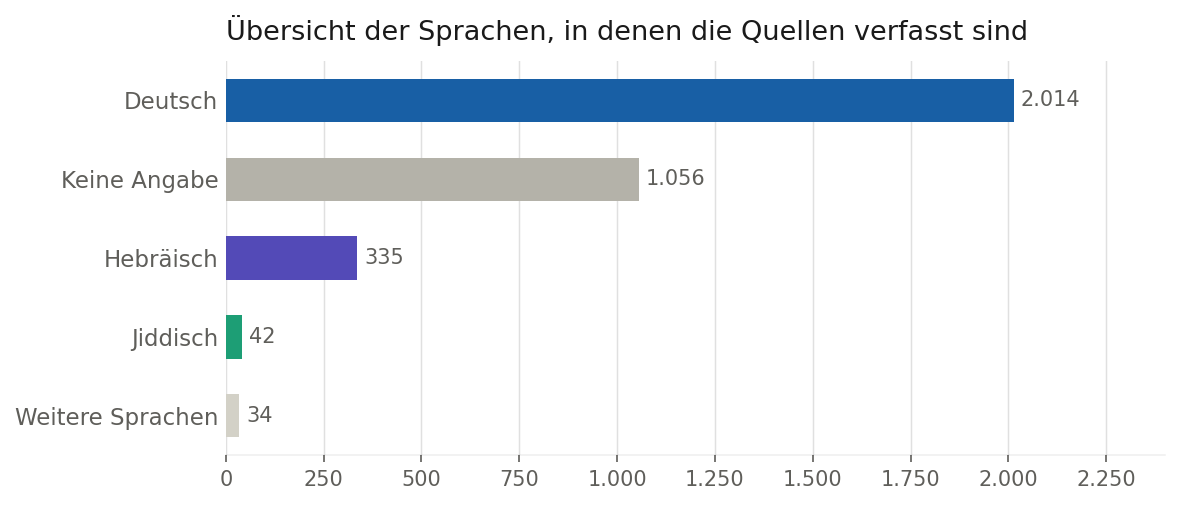
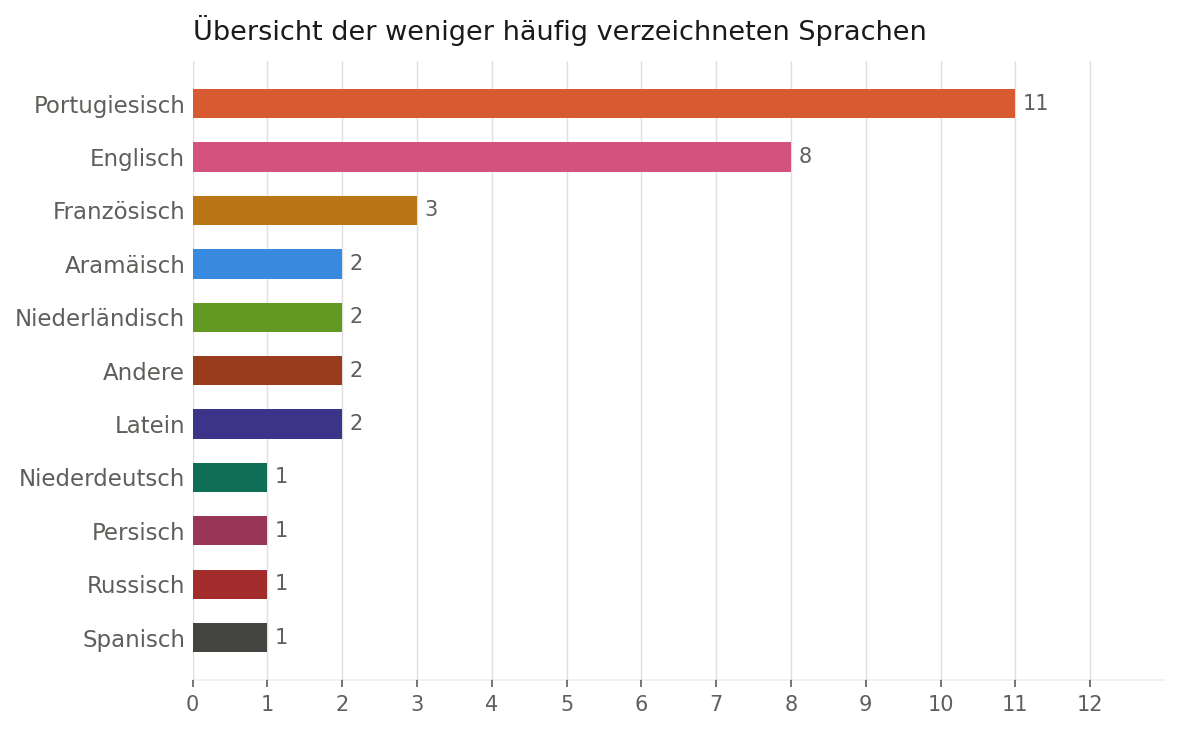
Perspectives and potential – Initial approaches to visualising metadata: here, the distribution of the languages in which the sources are written, based on an extract from the CAHJP inventory, Datenstrukturierung mit OpenRefine, 2026.
Perspectives and potential – Initial approaches to visualising metadata: here, the geographical references of the file collections based on an extract from the CAHJP inventory, 2026. (Map created with Leaflet © OpenStreetMap contributors)
Bibliography
- Inka Arroyo, “Raison d’être der Central Archives for the History of the Jewish People als virtuelles ‘Staatsarchiv’ der Diaspora,” in: Jüdisches Archivwesen. Beiträge zum Kolloquium aus Anlass des 100. Jahrestags der Gründung des Gesamtarchivs der deutschen Juden, at the same time 10. Archivwissenschaftliches Kolloquium der Archivschule Marburg, September 13–15, 2005, ed. by Frank M. Bischoff / Peter Honigmann (Publications of the Marburg School of Archival Studies 45), Marburg 2007, pp. 75–96.
- Daniel J. Cohen, “Jewish Records from Germany in the Jewish Historical General Archives in Jerusalem,” in: The Leo Baeck Institute Yearbook 1, 1 (1956), pp. 331–345. https://doi.org/10.1093/leobaeck/1.1.331
- Elisabeth Gallas, Das Leichenhaus der Bücher. Kulturrestitution und jüdisches Geschichtsdenken nach 1945, Schriften des Simon-Dubnow-Instituts 19, Göttingen / Bristol 2013.
- Jason Lustig, A Time to Gather. Archives and the Control of Jewish Culture, New York 2022.
- Miriam Rürup, “Wessen Erbe? Deutsch-Jüdische Geschichtsschreibung nach 1945 – das Hamburger Beispiel,” in: Kalonymos 19, 4 (2016), pp. 4–9.
- Verena Laura Schenk zu Schweinsberg, Der Bestand 522-1 Jüdische Gemeinden im Staatsarchiv Hamburg. Geschichte, Teilung und Bedeutung für die jüdisch-deutschen Beziehungen (e-Papers der Archivschule Marburg. Hochschule für Archivwissenschaft 19), Marburg / Lahn 2023, https://open.uni-marburg.de/.
- Björn Siegel, “Verworrene Wege: Die Gründungsphase des IGdJ,“ in: 50 Jahre – 50 Quellen. Festschrift zum Jubiläum des Instituts für die Geschichte der deutschen Juden, ed. by IGdJ, Hamburg 2016, pp. 26–53.
- Jürgen Sielemann, “Skrupellose Denunziation. Die personenkundliche Arbeit des Staatsarchivs Hamburg im ‚Dritten Reich‘,” in: Archivar 70, 4 (2017), pp. 385–390.
- Jürgen Sielemann, “Die personenkundliche Abteilung des Staatsarchivs Hamburg im NS-Staat und der Nachkriegszeit. Von der Judenverfolgung zur ‚Wiedergutmachung‘,“ in: Wie mächtig sind Archive? Perspektiven der Archivwissenschaft, ed. by Rainer Hering, Dietmar Schenk, Hamburg 2013, Veröffentlichungen des Landesarchivs Schleswig-Holstein, pp. 141-163.
Footnotes
- See Hannah Arendt, Jewish Cultural Reconstruction Field Reports, 1948–1951, Activity Report No. 18, February 15–March 10, 1950, published in: Key Documents on German-Jewish History, https://dx.doi.org/10.23691/jgo:source-126.en.v1 [March 12, 2026]; Elisabeth Gallas, Jewish Cultural Assets in the Postwar Period. Hannah Arendt’s Report on the Situation in Hamburg, in: Key Documents on German-Jewish History, January 30, 2017. https://dx.doi.org/10.23691/jgo:article-89.en.v1 [March 12, 2026]. ↑
- Miriam Rürup, “Wessen Erbe? Deutsch-Jüdische Geschichtsschreibung nach 1945 – das Hamburger Beispiel,” in: Kalonymos 19, 4 (2016), pp. 4–9. During negotiations regarding the fate of the archive, the Jewish Trust Corporation also emphasized that, given the pressure and influence exerted by the Gestapo, the handover could not have been voluntary even as early as 1938. (Letter from the Jewish Trust Corporation to the Hamburg Reparations Office, Hamburg, November 10, 1955, StaHH, 522-2 Jüdische Gemeinde in Hamburg, No. 1015.) ↑
- Jürgen Sielemann, “Die personenkundliche Abteilung des Staatsarchivs Hamburg im NS-Staat und der Nachkriegszeit. Von der Judenverfolgung zur ‚Wiedergutmachung‘,“ in: Wie mächtig sind Archive? Perspektiven der Archivwissenschaft, ed. by Rainer Hering, Dietmar Schenk, Hamburg 2013, Veröffentlichungen des Landesarchivs Schleswig-Holstein, pp. 141–163, here: p. 150. In his essay, Jürgen Sielemann demonstrates a clear alignment with Nazi ideology and attests that both Archive Director Reincke and the Head of the Department of Personal Records, Hans Kellinghusen, displayed great zeal in implementing Nazi racial ideology (“imbued with National Socialist racial fanaticism,” ibid., p. 149). ↑
- Inka Arroyo, “Raison d’être der Central Archives for the History of the Jewish People als virtuelles ‘Staatsarchiv’ der Diaspora,” in: Jüdisches Archivwesen. Beiträge zum Kolloquium aus Anlass des 100. Jahrestags der Gründung des Gesamtarchivs der deutschen Juden, zugleich 10. Archivwissenschaftliches Kolloquium der Archivschule Marburg, September 13–15, 2005, ed. by Frank M. Bischoff / Peter Honigmann (Veröffentlichungen der Archivschule Marburg 45), Marburg 2007, pp. 75–96; Miriam Rürup, “Wessen Erbe? Deutsch-Jüdische Geschichtsschreibung nach 1945 – das Hamburger Beispiel,“ in: Kalonymos 19, 4 (2016), pp. 4–9; Björn Siegel, “Verworrene Wege: Die Gründungsphase des IGdJ,“ in: 50 Jahre – 50 Quellen. Festschrift zum Jubiläum des Instituts für die Geschichte der deutschen Juden, ed. by IGdJ, Hamburg 2016, pp. 26–53; Jürgen Sielemann, “Skrupellose Denunziation. Die personenkundliche Arbeit des Staatsarchivs Hamburg im ‚Dritten Reich‘,“ in: Archivar 70, 4 (2017), pp. 385–390; Verena Laura Schenk zu Schweinsberg, “Der Bestand 522-1 Jüdische Gemeinden im Staatsarchiv Hamburg. Geschichte, Teilung und Bedeutung für die jüdisch-deutschen Beziehungen“ (e-papers of the Marburg School of Archival Studies. University of Applied Sciences for Archival Studies 19), Marburg / Lahn 2023, https://open.uni-marburg.de/. ↑
- See for the meaning and function of Jewish archives: Jason Lustig, A Time to Gather. Archives and the Control of Jewish Culture, New York 2022. ↑
- Inka Arroyo, “Raison d’être der Central Archives for the History of the Jewish People als virtuelles ‘Staatsarchiv’ der Diaspora, ” in: Jüdisches Archivwesen. Beiträge zum Kolloquium aus Anlass des 100. Jahrestags der Gründung des Gesamtarchivs der deutschen Juden, zugleich 10. Archivwissen-schaftliches Kolloquium der Archivschule Marburg, 13.–15. September 2005, ed. by Frank M. Bi-schoff / Peter Honigmann (Veröffentlichungen der Archivschule Marburg 45), Marburg 2007, pp. 75–96, here: pp. 80, 84. ↑
- Elisabeth Gallas, Das Leichenhaus der Bücher. Kulturrestitution und jüdisches Geschichtsdenken nach 1945, Schriften des Simon-Dubnow-Instituts 19, Göttingen / Bristol 2013, p. 245. ↑
- Jason Lustig, A Time to Gather. Archives and the Control of Jewish Culture, New York 2022, p. 133. ↑